
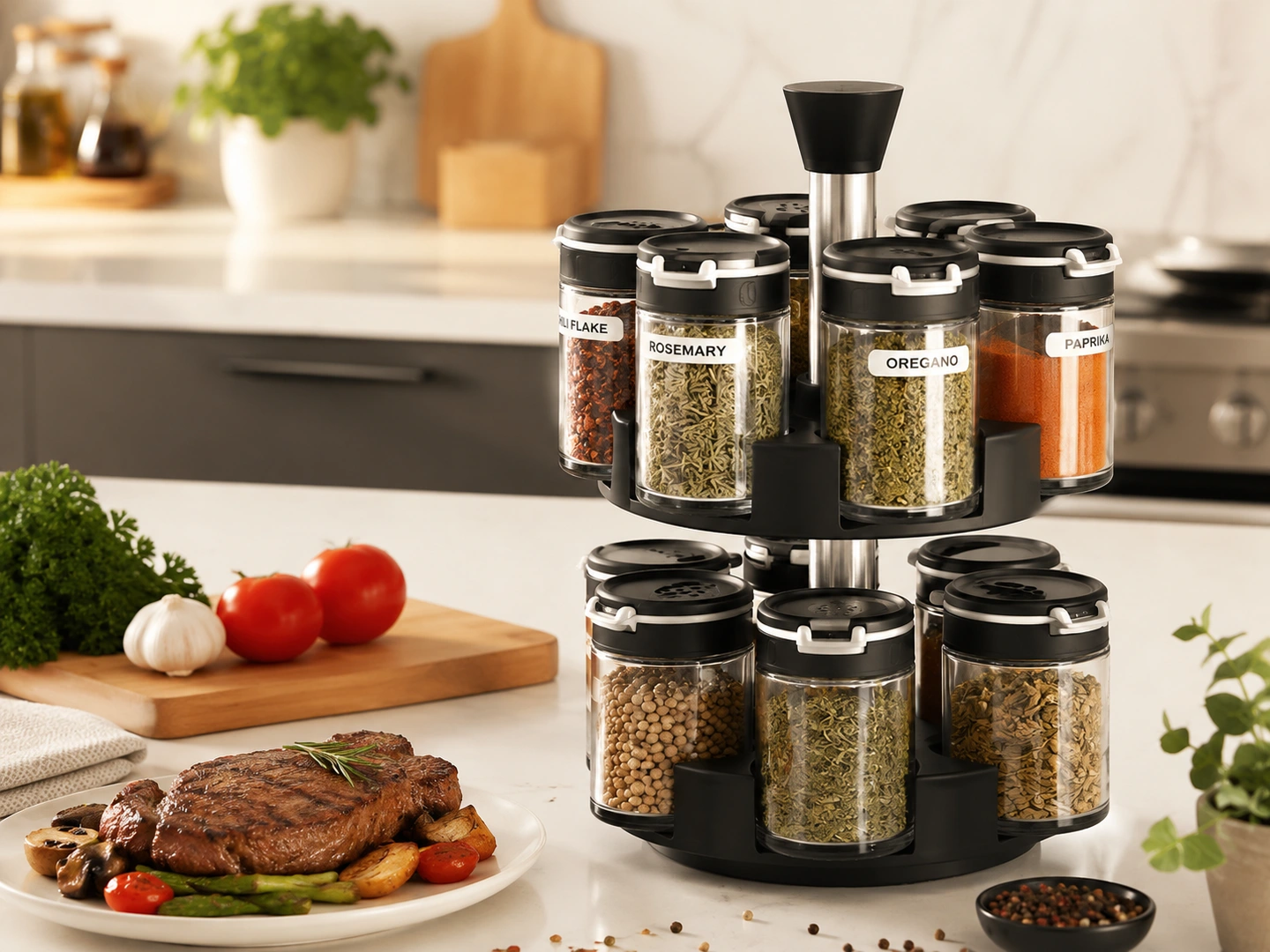
A rotating spice rack set sells better when shoppers can see the benefit within a few seconds. It is not enough for the rack to spin. The jars need to be visible, easy to take out, simple to refill, and packed well enough to arrive without broken glass or loose parts.
Many return problems come from daily-use friction. The base wobbles after the jars are loaded. The label faces the wrong way. The lid is hard to understand. The jar count looks useful online but feels too large for a small kitchen. For retail buyers, these problems turn a good kitchen organization idea into complaints, slow-moving stock, and extra service work.
A better approach is to source rotating spice rack sets as shelf-ready systems. The rack, jars, lids, labels, carton, and custom packaging all have to work together. SinoGlass offers several rotating spice rack options, including Lazy Susan styles, dual-dispensing jar sets, and two-tier racks, so buyers can build an entry-level item, a family kitchen set, or a private label seasoning display without forcing every channel into one SKU.
Why Do Some Rotating Spice Rack Sets Move Faster In Retail?
A rotating spice rack usually wins attention because it promises order. But on the shelf, the product still has to answer one simple question: will this make cooking easier every day? If the shopper cannot see that answer quickly, the product becomes just another kitchen organizer.
Retail buyers should look beyond the first product photo. A spice rack organizer that gives clear access, label visibility, and a tidy jar layout is easier to sell than one that only claims 360-degree rotation.
Visibility Helps The Shopper Decide Faster
A spice rack set with visible jars feels more useful because shoppers can imagine where each seasoning goes. Labels also matter. If the label area is too small, badly placed, or hidden when the rack turns, the product loses part of its selling story.
SinoGlass’s Lazy Susan Spice Rack includes labels and can support custom label material and text. That is useful for private label buyers because labels are not just decoration. They help the end user recognize spices faster, and they help retailers explain the product with fewer words. For a lazy susan spice rack SKU, the label area and jar orientation are part of the selling point.
Easy Access Reduces Daily Use Friction
A rotating spice rack supplier should think about loaded use, not empty display. A rack can spin smoothly when empty, then feel different once twelve glass jars are added. Buyers should test the rack with filled jars, not just a clean showroom sample.
The jar should be easy to remove, open, refill, and return to the rack. If the shopper needs two hands every time, the product may still look good but feel less convenient after purchase. When comparing a rotating spice rack supplier, sample testing with loaded jars is a more useful check than catalog photos alone.
Jar Count Must Match Real Kitchens
More jars are not always better. A 6-jar or compact set can fit smaller kitchens, gift channels, or beginner cooking lines. A 12-jar spice rack set works better for family kitchens and larger retail displays. A two-tier structure can offer more capacity, but it also needs height and balance checks.
SinoGlass lists different rotating spice rack formats in its rotating spice rack category, including 12-jar sets and two-tier options. This gives buyers room to plan a retail range instead of relying on one standard rack for every market.
Which Product Details Help Reduce Returns?
Returns usually start when the product does not behave the way the customer expected. The idea of a rotating spice rack is attractive. The trouble comes from lids, labels, weak packaging, unsteady rotation, or jar sizes that do not match the buyer’s shelf promise.
Rotation Stability Should Be Tested With Loaded Jars
A buyer should rotate the sample after the jars are filled. This simple check tells more than a product image. Does the base stay steady? Do the jars touch each other? Does the upper layer feel heavy? Can a shopper turn the rack without dragging it across the countertop?
For two-tier products, the center column, jar spacing, and bottom support all matter. A stable rack gives the product a better chance of avoiding bad reviews because the daily motion feels controlled.
Lid Design Changes The User Experience
The lid is one of the main return points in seasoning products. A lid that is hard to open, hard to refill, or confusing to twist may frustrate the user even if the rack looks premium.
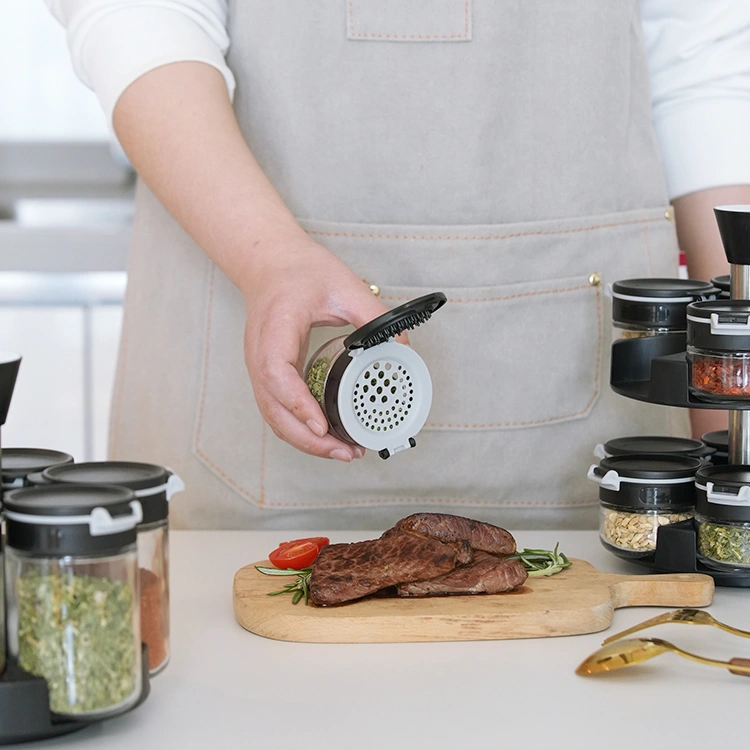
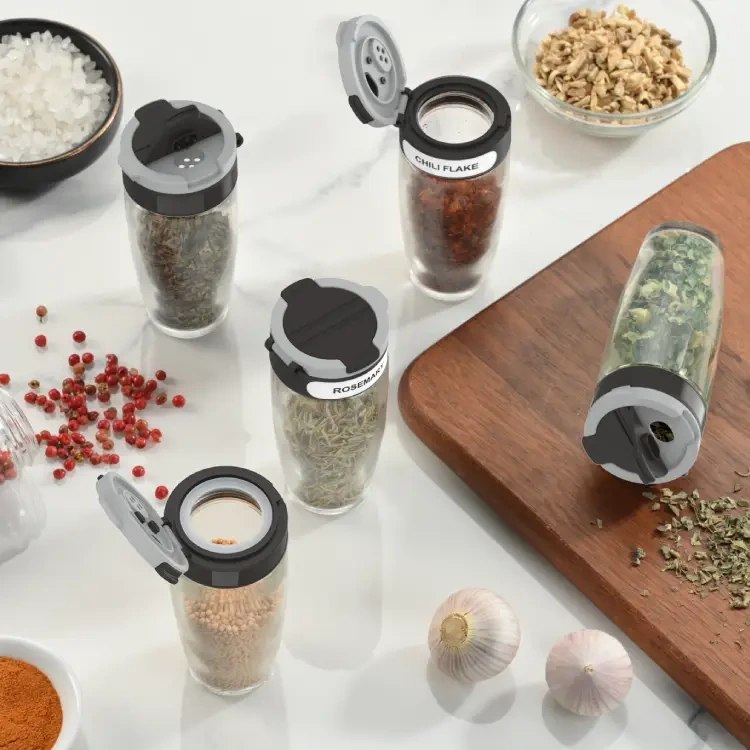
The Rotating Spice Rack & Jars Set uses dual dispensing jars, and the lid flips open for easier filling. That kind of detail gives retailers a stronger story than “comes with jars.” It also helps buyers position the set for everyday cooking, where pour, sprinkle, fill, and clean are repeated often.
Packaging Should Protect The Full Set
A rotating spice rack is not one item in a box. It is a glass-and-plastic set with several parts. Carton protection should cover the rack body, jars, lids, labels, and any accessories. A good sample can still become a weak order if the color box or master carton is not planned well.
Before approval, buyers should ask for color box size, case pack, carton weight, product packing photos, and protection method. If broken jars or loose lids become a return problem, the product concept is not the issue. The packing control is.
How Should Buyers Build A Rotating Spice Rack Range?
A spice rack range works best when each SKU has a clear role. Some products should be compact and simple. Some should feel like full kitchen organization sets. Some should be built for gift or private label packaging.
Compact Sets Suit Entry-Level Buyers
Compact rotating spice rack sets work well for small apartments, new homeowners, and first-time kitchen organization buyers. A lazy susan spice rack is easier to display and easier to understand when the channel needs a simple entry item. The price point is often easier to test, too.
For these SKUs, buyers should focus on neat shape, smooth rotation, clear labels, and simple packaging. A compact set does not need to do everything. It needs to solve one problem well.
Two-Tier Sets Suit Family Kitchens
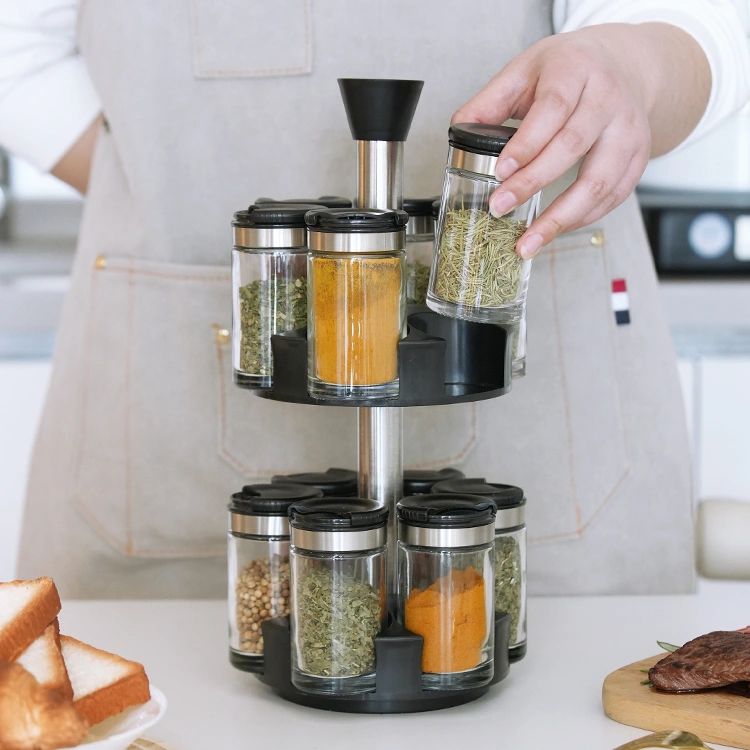
A two-tier rotating spice rack can carry a stronger complete seasoning system story. It suits family kitchens, countertop displays, and channels where shoppers want more jars in one organized set.
The trade-off is that two-tier products need more careful checks. Height, balance, jar removal, carton strength, and shelf footprint should be confirmed before mass production. A two-tier rack that feels stable and easy to use can support a higher-value retail position.
Private Label Packaging Makes The Set Easier To Sell
The product should not arrive as loose function plus plain box. For private label buyers, logo, labels, color matching, rack color, jar size, accessories, and packaging decide whether the rack feels like a planned retail item.
SinoGlass can support OEM work for rotating spice rack sets, including custom labels and packaging. For buyers building a kitchen organization line, this is where the supplier matters. A controlled set is easier to photograph, list, ship, and reorder.
What Should Buyers Ask Before Bulk Orders?
A rotating spice rack order should not be based on one attractive photo. The RFQ should collect enough detail to prevent surprises during sample approval and shipment.
Buyers can start with these checks:
| Buyer Check | Why It Matters |
|---|---|
| Jar count and jar capacity | Affects shelf story, carton size, and target kitchen use. |
| Rotation with loaded jars | Shows whether the rack feels stable in real use. |
| Lid and label design | Impacts daily use, visibility, and refill experience. |
| Color box and carton data | Helps freight planning and reduces shipping damage. |
| OEM scope | Keeps logo, label, rack color, and packaging changes under control. |
Keep The First Custom Order Focused
Private label buyers often want to change too many things at once. For a first order, it is usually safer to focus on logo, labels, packaging, and a stable jar/rack combination. New molds, many colors, and complex accessories can wait until sales data proves demand.
SinoGlass’s OEM/ODM service can help buyers connect product selection, packaging, sample confirmation, and production. That is more useful than treating customization as a late decoration step.
Conclusion
Rotating spice rack sets sell better and get fewer returns when the product works as a full retail system. Smooth loaded rotation, visible labels, practical jar count, easy lid use, strong carton packing, and focused customization all matter. Shoppers may buy the idea of a tidy kitchen, but they keep the product only when daily access feels easy.
SinoGlass gives buyers several rotating spice rack choices, from Lazy Susan styles to dual-dispensing jar sets and two-tier seasoning racks. If the next kitchen organization order needs better shelf appeal and fewer preventable return issues, buyers can first confirm jar count, packaging, label design, and custom scope, then discuss the right rotating spice rack setup with SinoGlass.
FAQs
Q1: What makes a rotating spice rack easier to sell in retail?
A1: Clear labels, smooth rotation, practical jar count, steady structure, and protective packaging help the product sell better.
Q2: Can SinoGlass rotating spice rack sets support private label orders?
A2: Yes. We can discuss logo, labels, rack color, jar options, accessories, and packaging for OEM projects.
Q3: How should buyers test a rotating spice rack sample?
A3: Test rotation with loaded jars, lid use, label visibility, carton protection, and shelf display fit.