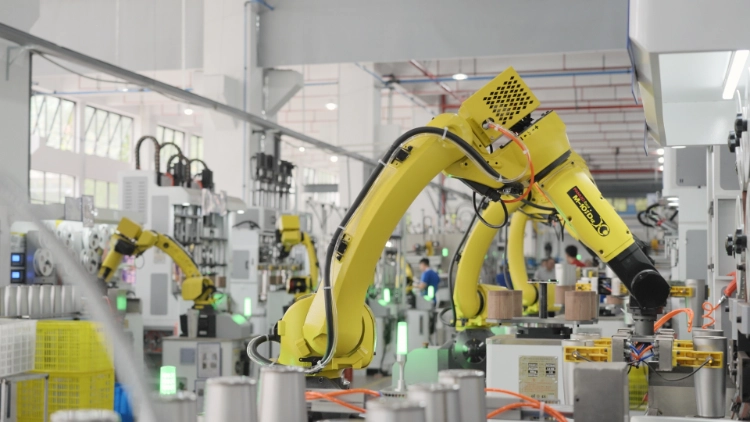
Robotic handling arms move bottle parts between stations on the automated line at the SinoGlass works.
The Double-Wall Construction
A stainless steel vacuum bottle is a double-walled metal container in which an evacuated gap separates the inner vessel from the outer shell. The construction is rated by how long it holds drink temperature: insulation tests read the contents at 6, 12 and 24-hour checkpoints from a defined fill temperature, and a passing bottle is one whose readings stay inside the standard’s limits at every checkpoint.
إن مجموعة منتجات سينو جلاس provides a starting point for reviewing available drinkware designs. SinoGlass is headquartered in Qingdao, Shandong, China, with stainless steel vacuum-bottle manufacturing in Yongkang, Zhejiang.
Key Takeaways
- Forming, cleaning and welding prepare the inner vessel and outer shell for evacuation.
- Removing the gas kills conduction and convection across the gap; conduction through the neck and solid supports and radiation across the gap remain the two escape routes heat still uses.
- Clean surfaces and sound seals help maintain the vacuum over time.
- Checks for liquid leakage and thermal performance address different defects.
Preparing the Steel Components
Stainless Steel Materials
Grades 304 and 316 are widely used in food-contact applications and are often described commercially as food-grade stainless steel. Grade 316 contains molybdenum and generally offers greater resistance to chloride-related corrosion than 304. The suitable choice depends on the intended beverages, cleaning conditions and product design; the grade designation alone does not establish that a finished bottle complies with every food-contact requirement.
For the United States, the applicable FDA food-contact requirements depend on the materials, components and intended conditions of use. In Germany, LFGB requirements apply alongside relevant EU food-contact rules. These are regulatory requirements, not blanket product certifications: neither a steel grade nor a reference to FDA or LFGB substitutes for documentation covering the finished bottle and its intended use.
Buyers should request material specifications and relevant test documentation for the particular model, including its seals, coatings and other food-contact components. Documentation should match the destination market and intended use rather than simply repeating a food-grade claim. The FDA guidance on food-contact materials و Germany’s LFGB provisions explain the relevant regulatory framework.
Because a stainless steel inner vessel spends its life filled with beverages that may carry acids and chlorides, both the steel and everything that touches it have to resist that attack.
Any plastic in contact with the steel therefore excludes chlorides and other aggressive constituents that could drive stress corrosion cracking, and the contact itself stays dry: a wet bottom seal, or a bottom cap that does not sit tight against the shell, lets water into the crevice and starts crevice corrosion.
For example, the bottom seal must be dry, and the bottom cap must be well fitted against the shell. If water can penetrate between the plastic bottom and the shell, there is a risk of crevice corrosion. The plastic materials used, e.g. for cups and handles, should not contain any aggressive constituents.
Forming the Shell and Liner
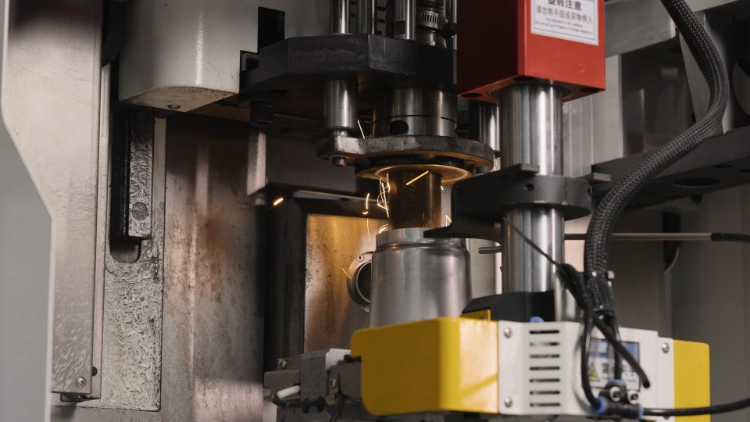
A forming machine shapes the stainless steel shell and liner into cylindrical vessel components during vacuum flask production.
The steel components are formed before assembly. For a supplier-specific overview, see SinoGlass manufacturing information.
The inner vessel and the outer shell are usually made by deep drawing from strip or sheet, and are then welded. The weld must be smooth and free from defects, and should preferably be continuously welded and fully penetrated.
Forming brings the inner vessel and outer shell to the dimensions needed for assembly. The top is then trimmed and necks are formed. Shells may be formed whole or produced by welding longitudinal or circular seams.
Precision of the final shape and size is important. For example, deformation of the neck of the inner vessel may make assembly impossible.
The inside of the outer shell and the outside of the inner vessel are then cleaned carefully to avoid outgassing subsequently. Surface contamination such as drawing lubricant, polishing compound, dust or grease can cause high outgassing, which has a major effect on vacuum stability.
Cleaning Before Assembly
The metal surfaces are cleaned and dried before welding. After the various treatment steps, the parts should be washed in clean water and dried. It is very important that deposits of foreign matter, such as oil, remain no longer than necessary, since chlorides in the water, oil or grease can cause local attack.
Steel brushes, grinding wheels and other tools containing carbon steel should not be used, since iron particles transferred to the surface may cause pitting corrosion. This also applies to treating with brushes and tools that have previously been used on carbon steel.
Oil, particles and moisture are removed from parts before the vacuum space is sealed.
- Use clean fluid
- Renew the fluid regularly
- Avoid contamination with oil or particles
- Monitor the washing sequence
- Check the drying operation.
Joining, Insulating and Finishing the Bottle
Welding the Bottle Body
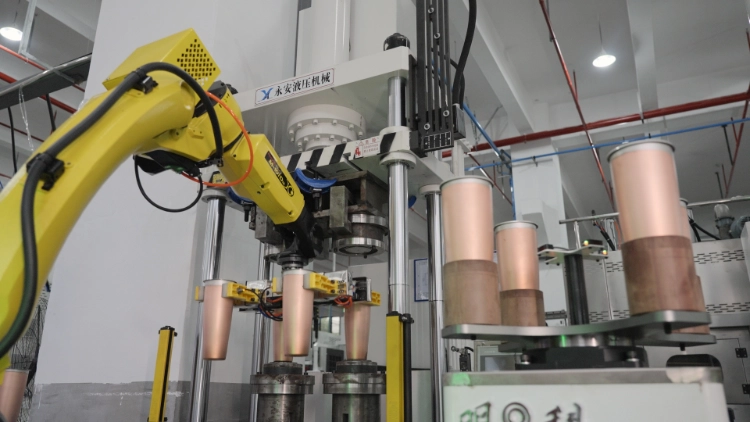
An automatic welding machine joins the bottom to an inner vessel before the liner is nested into its shell.
The stainless steel components are joined by welding. The equipment should be kept in a special area or workshop.
The working area should be kept separate from areas where carbon steel is being processed. Tools must be clean and not used for other materials.
The welding parameters must be adapted to the plate thickness in order to prevent burn-through. The weld joint must be as smooth as possible in order to avoid any crevices in which residues of the beverage or cleaning agents may remain. Filler material may need to be selected and tested on a case-by-case basis.
Creating the Vacuum
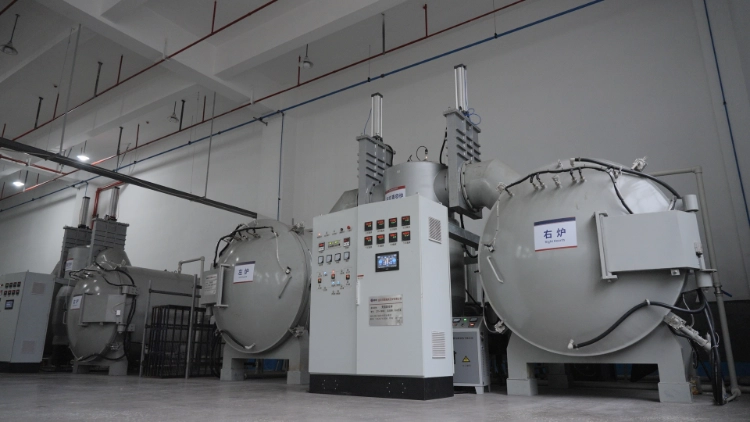
High-vacuum brazing furnaces evacuate the gap between liner and shell and seal it while hot.
The gap between the walls is evacuated and sealed. The vacuum between the inner vessel and the outer shell must be maintained for the lifetime of the bottle.
In vacuum-furnace processing, air is pumped from the gap while temperature is controlled. The evacuation process must be carried out at a carefully controlled temperature.
After evacuation, the bottle is sealed. The evacuated gap reduces gas conduction and convection, while solid connections and radiation still transfer heat.
Heat transfer by radiation is reduced by silvering or copper-plating the facing surfaces of the vacuum gap; the low emissivity of the plated surfaces reflects radiant heat back toward the contents. SinoGlass records the copper-plated liner as lifting heat retention by roughly 30 percent over an unplated gap.
Surface Treatment and Finishing
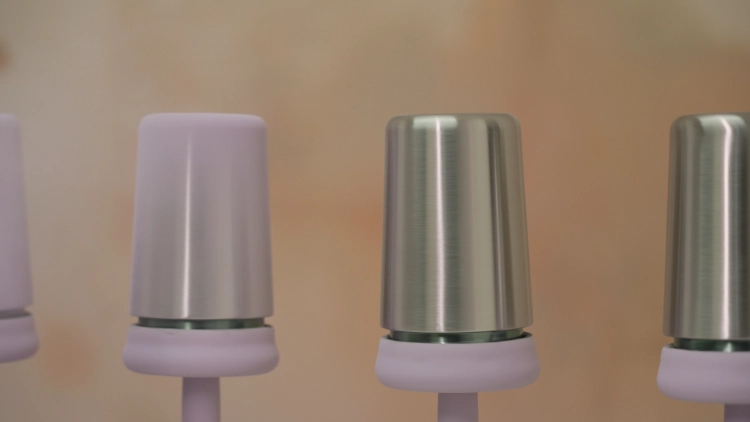
A spray coating process applies the selected color and protective finish to stainless steel water bottles, including painted and powder-coated surfaces.
The outer surface is finished after forming and assembly. The outer surface of the shell may be polished or brushed. This is normally done after assembly and evacuation.
Finishing is where the carbon-steel rule of the cleaning stage bites again: polishing media or tools that carry iron embed particles into the finished surface and undo the corrosion resistance the polish was meant to deliver. Media and tools entering the finishing area are therefore checked iron-free, and the corrosion check on a polished batch is judged against that rule.
The outer shell may also be painted. For the inner vessel, smooth surfaces are preferred because deposits and stains are less likely to adhere to them.
Assembly and Packaging
The closure and seals are fitted to the bottle. The bottle may have a stopper, handles, a pouring lip or a bottom cap, depending on its design.
At final assembly the material rules from the steel section become pass-or-fail checks rather than new requirements: plastic parts are fitted so that no water can reach the steel behind them, the bottom seal goes on dry and fully seated against the shell, and the packing material shipped with the bottle is dry as well.
It is also important that the plastic material does not contain any aggressive constituents that can cause corrosion. The packing material should be dry.
Checking the Finished Bottle
Testing Finished Bottles
Finished bottles are checked for leaks and thermal performance. The thermal check is run against the governing product standard (GB/T 29606 for vacuum cups, GB/T 40355-2021 for vacuum-insulated containers), so the quoted holding time always means “at 6, 12 or 24 hours from the standard fill temperature,” never “for several hours” in the abstract.
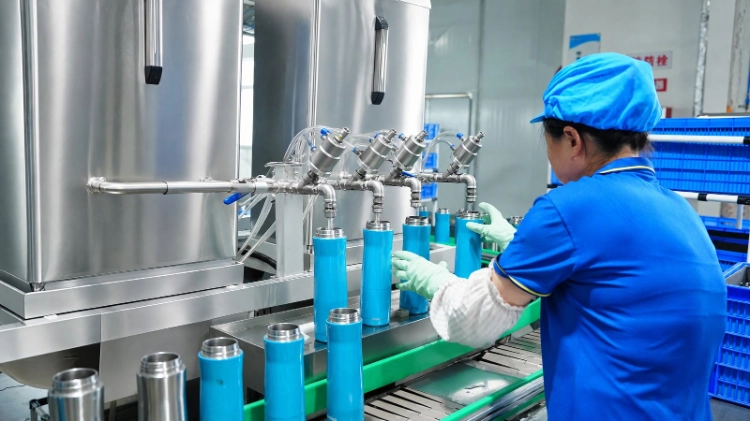
A worker loads finished bottle bodies into the leak test station, where each bottle is checked before it is packed.
Liquid leakage through the closure and poor thermal insulation are different defects. A test with hot or cold liquid can reveal thermal defects, but may not show small leaks in the vacuum gap.
After sealing, the bottle’s thermal-retention performance is evaluated using a hot-liquid test. The bottle is filled with water at the temperature and fill level specified by the applicable standard. After the specified test period—for example, 6 or 12 hours—the temperature of the liquid is measured. The unit passes if the retained liquid temperature meets or exceeds the standard’s minimum requirement. The outer-shell temperature may be checked separately as an auxiliary screening indicator for heat leakage, but it is not normally the primary pass/fail criterion for thermal retention.
The life of the bottle also depends on vacuum stability. Gas slowly released by residues inside the sealed gap raises its pressure over months and years, and a poor vacuum shows up first as a warm outer wall and a sharp drop in insulation. This is why surface cleanliness is enforced upstream of sealing instead of being tested for afterwards.
Manufacturing Faults and Their Causes
Fault tracing follows the two paths separately. On the vacuum side, lost insulation usually starts at the neck: a faulty weld there admits gas into the gap. Porosity in the weld, lack of penetration, a cold overlap or a crack can be the root cause, and a sharp blow that cracks the bottle base opens the same path from below.
Inner-vessel faults point back to process discipline rather than to the steel itself: poor weld quality, heat tint left after welding, iron embedded from carbon-steel tooling, and incomplete pickling and passivation each leave the weld area open to corrosion. Forming defects — laps, folds and deep scratches — fail the same way, by giving corrosion somewhere to start.
استنتاج
SinoGlass is headquartered in Qingdao, Shandong, China. Buyers can use the manufacturing sequence above to organize questions about material selection, forming, weld quality, vacuum sealing and finished-product checks, then confirm the specifications and documentation for their chosen bottle.
To discuss a particular bottle design and its inspection requirements, اتصل بـ SinoGlass.
أسئلة متكررة
What is the difference between 304 and 316 stainless steel for water bottles?
Grade 304 (18/8) is the standard food-contact choice for water and coffee bottles. Grade 316 adds molybdenum, which raises resistance to chloride attack — relevant for salty or mineral-rich contents and aggressive cleaning regimes — at a higher material cost. The grade mark alone proves nothing about compliance: what decides the choice are the intended beverages, the cleaning conditions and the finished-bottle documentation for the destination market.
Why does the outer wall of a vacuum bottle get hot?
A warm outer wall means the gap is no longer properly evacuated: with gas back in the space, heat conducts and convects outward again. Vacuum loss comes from neck weld defects, base cracks or gas released by residues left inside the gap, which is why leak and temperature checks sit at the end of the line rather than at the design stage.
How is the insulation performance of a bottle actually measured?
Under GB/T 29606 (vacuum cups) and GB/T 40355-2021 (vacuum-insulated containers), the bottle is filled at a defined starting temperature and the contents are read after set durations — typically 6, 12 or 24 hours — with the outer-shell temperature checked against the standard’s limit at the same checkpoints. A rating quoted without its fill temperature, checkpoint and limit is not a verified number.
What documents should a buyer request before ordering vacuum-insulated bottles?
Material specifications for the exact model, including seals, coatings and every food-contact part; migration and food-contact documentation matched to the destination market (FDA requirements in the United States, LFGB and EU rules in Germany, heavy-metal migration limits in China’s GB 4806.9); and the finished-bottle test records for the production batch, not a generic laboratory certificate.